Partnerships

2020 Q1 tax calendar: Key deadlines for businesses and other employers

Here are some of the key tax-related deadlines affecting businesses and other employers during the first quarter of 2020. Keep in mind that this list isn’t all-inclusive, so there may be additional deadlines that apply to you. Contact us to ensure you’re meeting all applicable deadlines and to learn more about the filing requirements. January […]

2020 Q1 tax calendar: Key deadlines for businesses and other employers Read More »

The next estimated tax deadline is September 16: Do you have to make a payment?

If you’re self-employed and don’t have withholding from paychecks, you probably have to make estimated tax payments. These payments must be sent to the IRS on a quarterly basis. The third 2019 estimated tax payment deadline for individuals is Monday, September 16. Even if you do have some withholding from paychecks or payments you receive,

The next estimated tax deadline is September 16: Do you have to make a payment? Read More »

Which entity is most suitable for your new or existing business?

The Tax Cuts and Jobs Act (TCJA) has changed the landscape for business taxpayers. That’s because the law introduced a flat 21% federal income tax rate for C corporations. Under prior law, profitable C corporations paid up to 35%. The TCJA also cut individual income tax rates, which apply to sole proprietorships and pass-through entities,

Which entity is most suitable for your new or existing business? Read More »

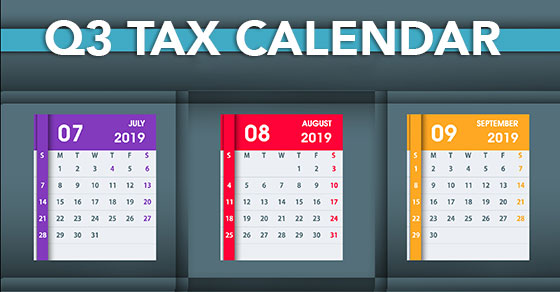
2019 Q3 tax calendar: Key deadlines for businesses and other employers

Here are some of the key tax-related deadlines affecting businesses and other employers during the third quarter of 2019. Keep in mind that this list isn’t all-inclusive, so there may be additional deadlines that apply to you. Contact us to ensure you’re meeting all applicable deadlines and to learn more about the filing requirements. July

2019 Q3 tax calendar: Key deadlines for businesses and other employers Read More »

Understanding how taxes factor into an M&A transaction

Merger and acquisition activity has been brisk in recent years. If your business is considering merging with or acquiring another business, it’s important to understand how the transaction will be taxed under current law. Stocks vs. assets. From a tax standpoint, a transaction can basically be structured in two ways: 1. Stock (or ownership interest).

Understanding how taxes factor into an M&A transaction Read More »

Beware the Ides of March — if you own a pass-through entity

Shakespeare’s words don’t apply just to Julius Caesar; they also apply to calendar-year partnerships, S corporations and limited liability companies (LLCs) treated as partnerships or S corporations for tax purposes. Why? The Ides of March, more commonly known as March 15, is the federal income tax filing deadline for these “pass-through” entities. Not-so-ancient history. Until

Beware the Ides of March — if you own a pass-through entity Read More »

When are LLC members subject to self-employment tax?

Limited liability company (LLC) members commonly claim that their distributive shares of LLC income — after deducting compensation for services in the form of guaranteed payments — aren’t subject to self-employment (SE) tax. But the IRS has been cracking down on LLC members it claims have underreported SE income, with some success in court. SE

When are LLC members subject to self-employment tax? Read More »

A refresher on major tax law changes for small-business owners

The dawning of 2019 means the 2018 income tax filing season will soon be upon us. After year end, it’s generally too late to take action to reduce 2018 taxes. Business owners may, therefore, want to shift their focus to assessing whether they’ll likely owe taxes or get a refund when they file their returns

A refresher on major tax law changes for small-business owners Read More »

Tax reform expands availability of cash accounting

Under the Tax Cuts and Jobs Act (TCJA), many more businesses are now eligible to use the cash method of accounting for federal tax purposes. The cash method offers greater tax-planning flexibility, allowing some businesses to defer taxable income. Newly eligible businesses should determine whether the cash method would be advantageous and, if so, consider

Tax reform expands availability of cash accounting Read More »